
One of the biggest challenges in online shopping is understanding what a product will actually look like and feel like outside of carefully staged product photography.
The product isn’t usually the problem. The photos look professional, the reviews are encouraging, and the website appears trustworthy. Yet many shoppers still leave without buying. More often than not, the issue lies somewhere between interest and checkout.
A photo can show a product. It can’t always explain it. That’s one of the strange things about online shopping. We have access to more products than ever before, yet we’re often making decisions with less confidence than we’d like. We can’t pick things up. We can’t test them. We can’t turn them over in our hands and inspect them from every angle. So, we look for substitutes. That’s where video and interactive content come in.
For shoppers using iPhones and iPads, these experiences often make the difference between feeling uncertain and feeling informed. Not because they’re flashy. Not because they’re trendy. Simply because they help people understand products in a way that static images rarely can. Understanding is what most shoppers are really looking for.
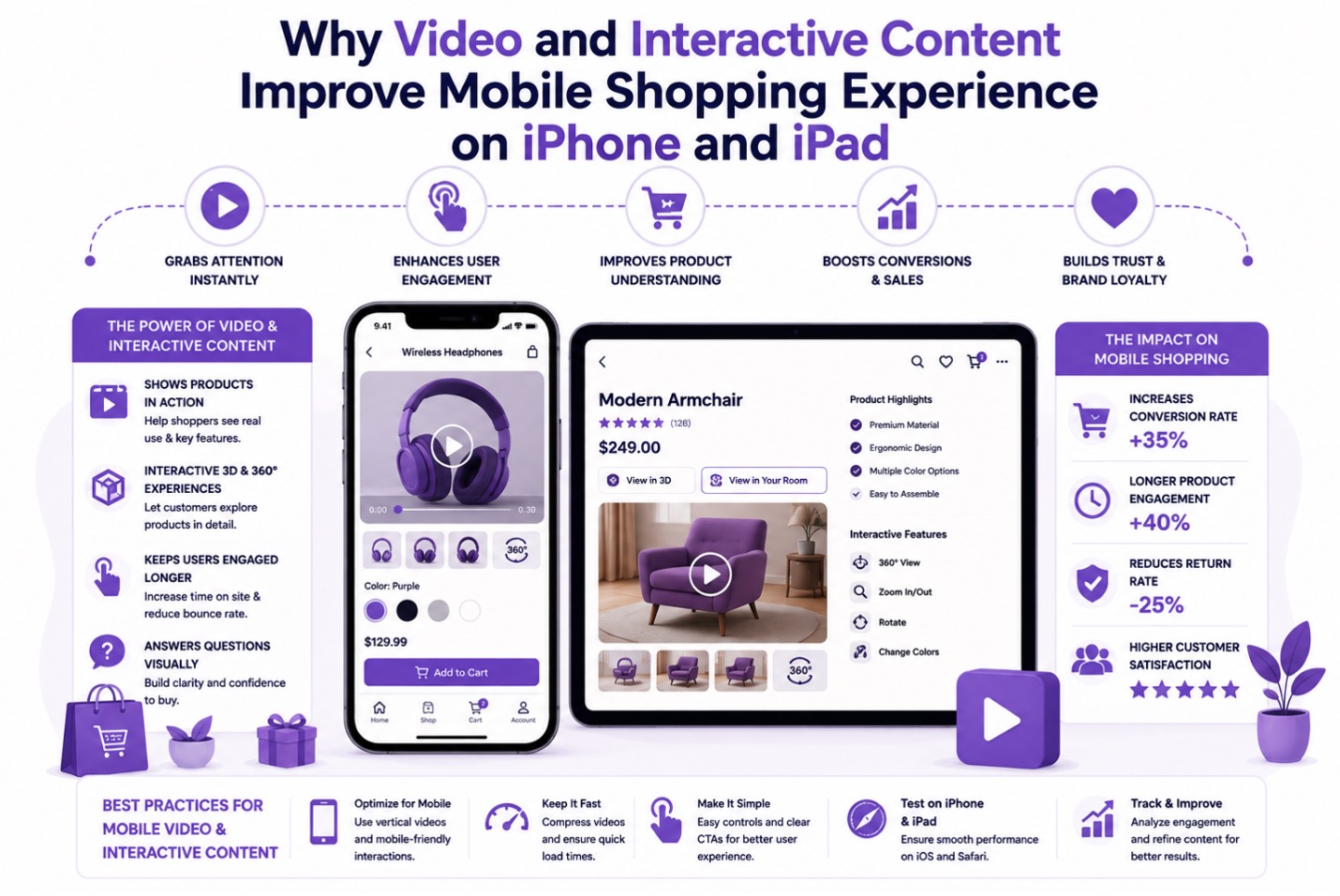
Why Movement Changes Everything
There’s something surprisingly powerful about seeing an object move. A jacket hanging in a photo looks one way. A jacket being worn while someone walks tells a completely different story.
The same applies to furniture, electronics, luggage, kitchen tools, shoes, and almost everything else sold online. Movement provides context. You see proportions. You notice texture. You understand scale. You pick up details that would never occur to you while looking at a still image.
Apple Devices Are Built for Visual Experiences
Anyone who has used an iPhone or iPad for a while develops certain expectations. Things should feel smooth. Images should look sharp. Videos should play instantly. Interactions should feel natural.
When those expectations are met, the shopping experience feels effortless. Retina displays play a huge role here. The first time you watch a well-produced product video on a modern iPhone, you notice details that would be easy to miss elsewhere.
Fabric textures become visible. Materials look more realistic. Colors feel more accurate. It’s a small thing. Until you’re deciding whether to spend money. Then it becomes a very important thing.
Most Shoppers Don’t Read as Much as Retailers Think
Retailers spend hours writing product descriptions. Shoppers spend seconds reading them. That’s not criticism. It’s reality. People skim. They scroll. They jump around. They look for answers rather than information.
If someone wants to know whether a carry-on suitcase fits under an airplane seat, they don’t necessarily want three paragraphs explaining the dimensions. They want to see it.
Video delivers answers in a format that requires almost no effort from the viewer. That’s one reason engagement tends to increase when product videos are present. People aren’t being asked to work harder. They’re being asked to observe.
Best Product Videos Feel Almost Boring
This might sound odd, but many of the most useful product videos aren’t particularly exciting. They’re practical.
A coffee machine making coffee. A backpack being packed. A chair being assembled. A phone case being attached to a phone. No dramatic music. No cinematic transitions. No exaggerated claims.
Just a product doing what it’s supposed to do. Those videos often outperform highly produced promotional content because they answer the questions shoppers actually have. People aren’t always looking for entertainment. They’re looking for reassurance.
Interactive Content Creates a Different Kind of Trust
Video helps shoppers watch. Interactive content helps them explore. That’s a meaningful difference.
Think about how naturally people interact with their iPhones. Swiping and pinching have become almost automatic. Nobody thinks about those actions anymore.
So, when a product page lets users zoom into details, rotate an item, switch colors, or examine features from multiple angles, it feels intuitive. The shopper becomes part of the process. They’re no longer being shown information. They’re discovering it. It tends to feel more trustworthy than claims.
Mobile Shopping Happens in Real Life, Not Ideal Conditions
One thing ecommerce discussion sometimes forget is where mobile shopping actually happens. Not at a desk. Not in a perfectly quiet environment. Usually somewhere much messier. On a train. In a waiting room. During a lunch break. Half-watching television. Standing in line for coffee.
People are distracted. They’re interrupted. They’re multitasking. Under those conditions, visual communication becomes incredibly valuable. A twenty-second demonstration can accomplish more than several minutes of reading. Not because people are lazy. Because they’re busy. There’s a difference.
Why iPads Encourage Longer Shopping Sessions
Shopping on an iPad feels noticeably different from shopping on an iPhone. Not better. Just different. The larger display changes behavior. People tend to slow down.
They compare products more carefully. They watch longer videos. They explore galleries in greater detail. Shopping behavior often differs between the two devices. An iPhone is frequently used for product discovery, while an iPad is more commonly used for deeper evaluation and comparison.
The bigger screen creates space for curiosity. It is surprisingly important in ecommerce. The more comfortable people feel exploring a product, the more confident they become about purchasing it.
Hidden Connection Between Trust and Transparency
Trust is often discussed as if it’s some complicated marketing concept. Most of the time, it isn’t. Trust comes from transparency. If shoppers can clearly see a product, understand how it works, and inspect its details, trust tends to develop naturally. Movement adds context that static images cannot provide. It becomes easier to judge scale, notice texture, and understand how a product functions in everyday use.
Product Galleries Have Quietly Changed
Product galleries used to be simple. A few images. Maybe a zoom feature. That was enough for a long time. Today, expectations are different. Shoppers increasingly expect a mix of images, videos, demonstrations, and interactive elements working together.
Many WooCommerce stores have adapted by integrating WooCommerce product videos directly into product galleries alongside traditional images. Solutions such as Product Gallery Videos for WooCommerce make it possible to showcase products from multiple angles, demonstrate key features, and provide shoppers with additional context without requiring them to leave the product page.
Engagement Comes from Answers
People often assume engagement is about keeping visitors on a page longer. Good engagement happens when shoppers keep finding answers.
They watch another video because they have another question. They zoom into a detail because they’re curious. They rotate the product because they want a better look. Every interaction reduces uncertainty. Every answer moves them closer to a decision.
The Bottom Line
The best shopping experiences don’t make people feel sold to. They make people feel informed. That’s a subtle difference, but it’s an important one.
Video and interactive content work because they respect how people naturally evaluate products. They answer questions visually. They reduce guesswork. They make products feel more tangible.
For iPhone and iPad users, those benefits become even more noticeable. Sharp Retina displays reveal details. Touch controls encourage exploration. Videos feel effortless to watch.
Taken together, these elements create something every shopper wants. Not more information. More confidence. It is often what turns browsing into buying.
If you liked this article, please consider sharing it with your friends and leaving a comment below. Also, don’t forget to “Like” us on Facebook and add the Apple Tech Talk channel to your Apple News app.
Steve David
Steve David is a Writer at TheCodeFish with 1 year of experience in content writing and digital marketing. He focuses on creating clear, SEO-friendly content related to digital marketing and eCommerce best practices, helping businesses improve their online presence and performance.




Leave a Comment
You must be logged in to post a comment.